


Who actually needs the authorisation?
- EU-established importers that act as the customs declarant for CBAM goods.
- Indirect customs representatives (e.g. freight forwarders) if they lodge the customs declaration in their own name.
Eligibility check-list
Before you hit “apply”, make sure you can tick all six boxes:| Requirement | Proof you will need |
| EU establishment | Valid EORI number registered in an EU Member State |
| Financial capacity | Latest financial statements or bank guarantee if requested |
| Operational capacity | CBAM compliance procedures & responsible person on record |
| Good conduct | No serious/repeated customs, tax, market-abuse offences in the last 5 years |
| Registry access | EU Customs Trader Portal login (same as ICS2 & POSEIDON) |
| Security (if requested) | Bank or insurance bond covering your projected CBAM certificate needs |
Application timeline & important dates
| Milestone | What it means | Practical advice |
| 28 Mar 2025 | EU CBAM Registry opens for authorisation requests | Portal: Customs Trader Portal → CBAM > Authorisation Management Module (AMM) |
| 15 Jun 2025 | End of the “early batch” window | Applications submitted before this date can take up to 180 days to be processed. |
| After 15 Jun 2025 | Standard processing time applies | Decisions must arrive within 120 days.* |
| 31 Aug 2025 | Recommended latest safe filing date | Gives the authority the full 120 days before 1 Jan 2026. |
| 1 Jan 2026 | Start of the definitive CBAM phase | Only ACDs may import CBAM goods. |
Contact your national CBAM authority to get access to the definitive CBAM portal (not Transitional Registry)
To become an authorized CBAM declarant, the registration process starts in the EU CBAM portal, not the CBAM’s transitional registry (the current online portal where importers are submitting quarterly CBAM reports). As a first step, you are required to contact your National Competent Authority (NCA), who will guide you and authorize your application. Each EU Member State has its own NCA responsible for processing CBAM-related registrations and declarations. To ensure a smooth start, Visit the official EU list to identify your NCA, and get in touch using the contact information provided. This step is mandatory before accessing the registry or submitting any declaration. Below, you will find a consolidated table listing the official contact details (name, email, phone number, and website) of all NCAs, compiled directly from the latest European Commission documentation.
| Country (Code) | Authority Name – NCA | Phone | Website | |
| Austria (AT) | Federal Ministry of Finance – Customs Authority | [email protected] | +43 502 335 60555 | https://www.bmf.gv.at |
| Belgium (BE) | Federal Public Service for Health, Food Chain Safety & Environment – Climate Change Service | [email protected] | +32 2 524 96 55 | https://www.health.belgium.be/en/cbam |
| Bulgaria (BG) | Executive Environment Agency | [email protected] | https://eea.government.bg/en | |
| Croatia (HR) | Ministry of Economy and Sustainable Development | [email protected] | +385 1 3717 111 | https://mingor.gov.hr |
| Cyprus (CY) | Department of Environment, Ministry of Agriculture, RD&E | [email protected] | https://www.moa.gov.cy | |
| Czechia (CZ) | Customs Administration & Ministry of the Environment | [email protected] | https://www.mfcr.cz | |
| Denmark (DK) | Danish Energy Agency | [email protected] | https://ens.dk/ansvarsomraader/cbam-og-co2-kvoter/cbam | |
| Estonia (EE) | Environmental Board | [email protected] | +372 662 5999 | https://keskkonnaamet.ee |
| Finland (FI) | Energy Authority | [email protected] | +358 29 5050000 | https://www.energiavirasto.fi |
| France (FR) | Ministry for the Economy, Finance and Industrial and Digital Sovereignty – DGDDI | [email protected] | +33 1 57 53 40 00 | https://www.douane.gouv.fr |
| Germany (DE) | German Emissions Trading Authority (DEHSt) | [email protected] | +49 30 8903 5050 | https://www.dehst.de/EN |
| Greece (EL) | Ministry of Environment and Energy | [email protected] | +30 213 1513 986 | https://ypen.gr |
| Hungary (HU) | National Inspectorate for Environment, Nature and Water | [email protected] | https://mbfsz.gov.hu | |
| Ireland (IE) | Environmental Protection Agency (EPA) | [email protected] | +353 53 916 0600 | https://www.epa.ie |
| Italy (IT) | Ministry of the Environment and Energy Security | [email protected] | +39 06 5722 1 | https://mite.gov.it |
| Latvia (LV) | State Environmental Service | [email protected] | +371 67 028 500 | https://www.vvd.gov.lv |
| Lithuania (LT) | Environmental Protection Agency | [email protected] | +370 5 272 7370 | https://aaa.lrv.lt |
| Luxembourg (LU) | Environment Agency (AEV) | [email protected] | +352 247 868 01 | https://aev.etat.lu |
| Malta (MT) | Environment and Resources Authority (ERA) | [email protected] | +356 2292 3500 | https://era.org.mt |
| Netherlands (NL) | Netherlands Emissions Authority (NEa) | [email protected] | +31 88 602 5500 | https://www.emissieautoriteit.nl |
| Poland (PL) | National Centre for Emissions Management (KOBiZE) | [email protected] | +48 22 56 96 510 | https://www.kobize.pl |
| Portugal (PT) | Portuguese Environment Agency | [email protected] | +351 210 519 400 | https://www.apambiente.pt |
| Romania (RO) | National Environmental Protection Agency | [email protected] | +40 21 207 11 00 | https://www.anpm.ro |
| Slovakia (SK) | Ministry of Environment | [email protected] | https://www.enviro.gov.sk | |
| Slovenia (SI) | Slovenian Environment Agency | [email protected] | +386 1 478 4000 | https://www.arso.gov.si |
| Spain (ES) | Spanish Climate Change Office (OECC) | [email protected] | +34 91 597 61 00 | https://www.miteco.gob.es |
| Sweden (SE) | Swedish Environmental Protection Agency | [email protected] | +46 10 698 10 00 | https://www.naturvardsverket.se |
Step-by-step: Filing your application
- Log in to the Customs Trader Portal and open the CBAM Registry.
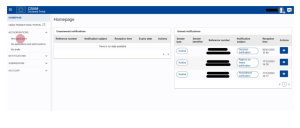 3. Fill in the on-screen form and upload supporting documents (financials, compliance procedure, contact details, any requested security).
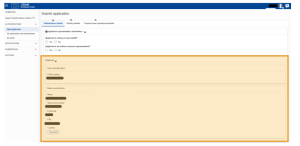
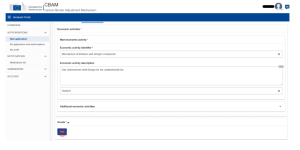
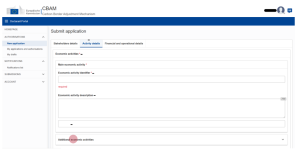
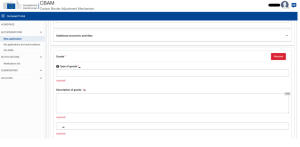
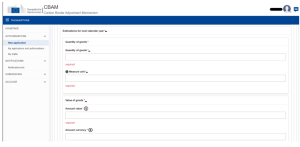
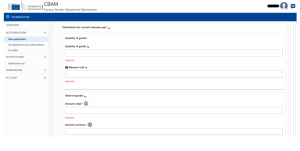 4. Submit. Your National Competent Authority (NCA) reviews the file and electronically consults the Commission and other NCAs if needed.
5. Track the status under “My authorisations”. The final decision arrives in the portal inbox.
6. If approved, your CBAM account is activated automatically—no extra action required.
4. Submit. Your National Competent Authority (NCA) reviews the file and electronically consults the Commission and other NCAs if needed.
5. Track the status under “My authorisations”. The final decision arrives in the portal inbox.
6. If approved, your CBAM account is activated automatically—no extra action required.
After approval: ongoing obligations
- Quarterly – keep at least 50 %P of the CBAM certificates you will need for the current year in your account.
- Annually – submit the CBAM declaration and surrender the exact number of certificates by 31 May (first declaration due in 2027 for calendar year 2026 imports).
- Records – retain all import and emissions data for five years.
- Change management – tell your NCA within 30 days if your company merges, changes legal form, or ceases CBAM imports.
Frequently asked questions
| Question | Answer |
| Is there a deadline for applying? | No fixed cut-off, but you must be authorised before the first arrival of CBAM goods from 1 Jan 2026 onward. Apply by 31 Aug 2025 to be safe. |
| Do I need to reconfirm the application after submission? | No. The authority will come back to you only if it needs extra information. |
| I import < 50 t a year—do I still need to declare? | No. Following the adoption of the Omnibus package, importers bringing in less than 50 tonnes per year are exempt from reporting requirements. |
| What if I expected to stay below 50 t but later exceed it? | Because the threshold is not in the law, you should already have the ACD status. Importing CBAM goods without it is a breach. Apply immediately and include all earlier 2026 imports in your first annual CBAM report. Penalties are set by each Member State. |
| Can I register retroactively? | The regulations do not provide for retroactive authorisation. Applications are only valid from the approval date forward. |
| Our goods enter through multiple EU countries—how do we report? | File one consolidated annual CBAM declaration in the Member State where your company is established, regardless of where customs clearance took place. |
| Is direct customs representation allowed? | Yes, indirect representatives may act as the declarant. If you use direct representation, your company (the importer of record) must hold the ACD status. |
Practical tips for a smooth application
- Start early: internal due-diligence (compliance check, financial capacity, emissions data readiness) often takes longer than filling in the form, especially when needing to provide sufficient proof for sufficient financial capacity.
- Automate data capture: align invoicing systems and customs brokers on CBAM codes early; mistakes in HS codes can void declarations later. (Mistakes or inconsistencies in HS codes between customs declarations and CBAM filings can invalidate your CBAM declaration, leading to penalties or re-submissions.)
- Budget for certificates: It’s important to have a clear picture of your potential CBAM certificate needs and carbon tax exposure for 2026—our team can help you forecast and prepare accordingly.
- Audit trail: keep a single, auditable spreadsheet or database linking every import entry number to its embedded-emission figure; this makes the annual declaration a two-hour job instead of two weeks.
Resources
- Regulation (EU) 2023/956 establishing the Carbon Border Adjustment Mechanism (CBAM)
- Implementing Regulation (EU) 2025/486 — application process & registry rules
- European Commission, CBAM Registry User Manual (April 2025)
- DG TAXUD, Default values for the transitional period (Annex 2 tables)
- CREA (2024), China Steel Brief
- IEEFA & JMK Research (2023), Steel Decarbonisation in India
- EBRD (2024), Low-Carbon Pathway for the Steel Sector in Türkiye
- IEA (2024), Ammonia Technology Roadmap
- MDPI (2024), Decarbonising China’s Primary Aluminium Industry
- Energy Cities (2024), 50 Shades of Hydrogen