


Introduction
CBAM compliance requires EU importers to report emissions not just for tier 1 suppliers but also across the broader supply chain, including tier 2 and beyond. However, due to the complex and evolving nature of CBAM, many importers and exporters may overlook these requirements, potentially leading to penalties and operational challenges. This blog emphasizes the importance of engaging with upstream suppliers to ensure full CBAM compliance.
Unveiling the 80/20 Rule
CBAM applies to imported iron, steel, aluminum, cement, fertilizer, hydrogen, and electricity products, where the shipment value is equal to or greater than EUR 150. Reporting for CBAM began in October 2023, and by the October 31st report for Q3/2024, EU importers must report real emissions data from their suppliers.
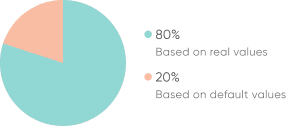
According to Article 5 of the CBAM implementing regulation (EU) 2023/1773, at least 80% of the product carbon footprint (PCF) must be based on real factory consumption values, with up to 20% allowed from default estimations provided by the EU Commission or other scientific emission datasets.
Upstream emissions: the importance of Tier 2 and beyond
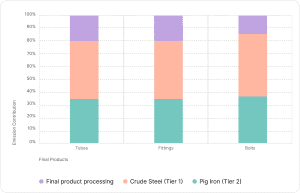
In industries like metals, particularly iron, steel, and aluminium, most emissions occur upstream during raw material production in tier 2 or beyond suppliers. Relying solely on tier 1 data makes it nearly impossible to meet the 80% real emissions threshold. If upstream suppliers do not track real emissions, importers have to rely on EU default values for tier 2 emissions, risking non-compliance and putting at risk the business relationship between tier 1 and the EU importer.
Carbon footprint of some products due to processing phases
Eliminating the misconception that EU default values can be used indefinitely – 09.08.2024 official CBAM FAQ (Questions 74,75, and 77)
The European Commission recently reconfirmed that for the Q3/2024 reporting deadline, EU importers must provide real emissions data, with no extensions for using default values. Importers must use all “possible/reasonable” efforts to gather this data. If unable to obtain it, they must prove their efforts and provide supporting documents in the CBAM Transitional Registry. Documents such as screenshots of emails, and supply chain engagement spreadsheet tables, are needed to prove your efforts.
Penalties for non-compliance range from EUR 10 to 50 per ton of CO2 emissions. The National Competent Authority (NCA) of each EU country will consider the means and resources that importers effectively allocate to collect the data. Three main criteria will be considered:
- Size and resources available to the company
- Amount of imports and percentage of CBAM goods imported
- Embedded emissions in CBAM goods
NCAs may also consider the repetition of these actions and follow-ups with third-country suppliers and their duration.
Why Real Data Matters
- Fair Competition: default values create disparities between EU and non-EU companies, undermining CBAM’s goal of encouraging global decarbonisation.
- Cost Efficiency: accurate data allows companies to identify inefficiencies, reducing production costs and ensuring fair carbon pricing.
- Accurate Representation: default values are derived from the top of 20% most carbon-intensive EU installations and could therefore significantly exceed your supplier’s actual emissions. Measuring and using real data ensures that you don’t overpay for carbon costs and more accurately reflects your true environmental impact.
In most cases, but especially in the iron, steel, and aluminium industry, tier 1 suppliers will almost never reach the needed 80% threshold alone, as most emissions happen during the production of the raw material itself, thus, in the factories of tier 2 suppliers or beyond.
If upstream suppliers do not track real CBAM emissions, tier 1 suppliers are forced to use EU default values for their raw materials, meaning quite certainly they will not reach the target of 80% of the CBAM product carbon footprint (PCF) being based on real values. This almost certainly leads to liability issues and therefore increased chances of fines in the range of 10 to 50 EUR per ton of greenhouse gas emissions.
Meeting the 80% PCF Threshold
To meet the 80% real emissions requirement, companies must rely on data from third-country suppliers. This process can be complex, time-consuming, and costly, especially if suppliers are unfamiliar with CBAM requirements or if the data is confidential.
If suppliers are uncooperative, importers can mitigate risks by including CBAM compliance clauses in contracts, with penalties for non-compliance. Strengthening relationships with suppliers and helping them gather the necessary data, particularly for precursor materials, is essential to avoid supply chain disruptions and ensure CBAM compliance.
The ClimEase CBAM software for all Tiers
CBAM extends beyond tier 1, requiring a comprehensive approach to emissions reporting that includes tier 2 and beyond.
To help both EU importers and international manufacturers navigate these complexities, our software offers a user-friendly interface that covers all tiers of your supply chain, ensuring fast, comprehensive, and CBAM-compliant emissions tracking. It also provides financial transparency, allowing EU importers and every supplier to see the impact of emissions on the EU’s carbon pricing.
By engaging with upstream suppliers and utilizing our software, you can meet the 80% real emissions threshold with ease, avoid penalties, and position your company competitively in a CBAM-compliant future.